


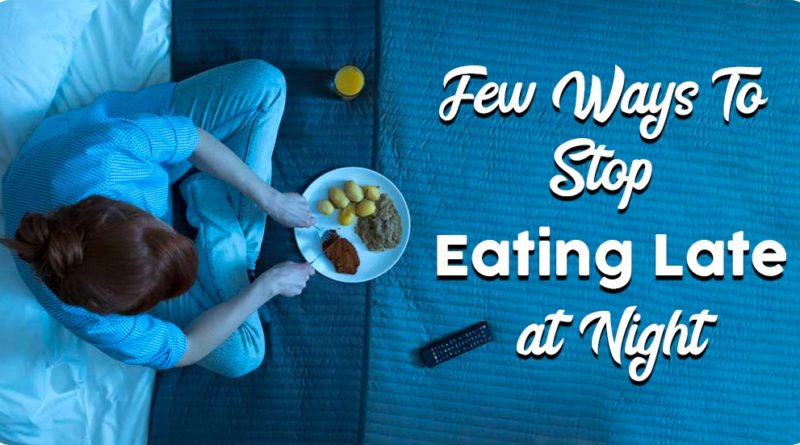
Few ways to stop eating late at night
Many people have a habit of eating late at night, and this night time eating can lead to increased calorie intake and weight gain. So this article talks about some clever and effective ways that can help you to stop snacking late at night.
• Identify the cause: Never skip your meals during day time as this may result in extreme hunger at night. Distribute your meals equally to avoid nighttime eating.
• Identify your triggers: If you can identify and monitor what triggers you to eat at night, then you will be able to break this eating cycle. Track your eating habits and feelings to identify your pattern.
• Have a routine: Structure your sleeping and eating time as it will help you spread your meals over the day and make you feel less hungry at night. Lack of sleep is linked to increased calorie intake and obesity. A fixed routine can help you break this cycle of unhealthy behaviour.
• Plan your meals: When you have a meal plan, it reduces the chances of making poor food choices and impulsive eating. With a meal plan, your food intake is equally distributed, and this also helps to keep hunger at bay.
• De-Stress: Stress and anxiety lead to emotional eating at night, but this is not the way to relax and let go of negative emotions. Try hot baths, meditation, deep breathing, exercise, yoga or stretching to manage stress levels.
• Include protein in every meal: Proteins keep you full and satisfied for a longer period. It helps to prevent snacking at night as high protein foods tend to reduce cravings.
• Keep junk food away: Remove any kind of high sugar, high-fat junk food from your house. It prevents snacking and overeating.
• Keep yourself distracted: Plan something that you enjoy doing to keep your mind occupied to prevent mindless late-night snacking.
• Seek support: If you are not able to manage things on your own, then you may seek professional help. When you create an emotional support network, it will help you to manage your negative emotions in a better way than snacking late at night.
References :
- Weltens, N., Zhao, D., & Van Oudenhove, L. (2014). Where is the comfort in comfort foods? Mechanisms linking fat signaling, reward, and emotion. Neurogastroenterology and motility : the official journal of the European Gastrointestinal Motility Society, 26(3), 303–315. https://doi.org/10.1111/nmo.12309
- Walsh, J. M., Wheat, M. E., & Freund, K. (2000). Detection, evaluation, and treatment of eating disorders the role of the primary care physician. Journal of general internal medicine, 15(8), 577–590. https://doi.org/10.1046/j.1525-1497.2000.02439.x
- Sheehan, D. V., & Herman, B. K. (2015). The Psychological and Medical Factors Associated With Untreated Binge Eating Disorder. The primary care companion for CNS disorders, 17(2), 10.4088/PCC.14r01732. https://doi.org/10.4088/PCC.14r01732
- Kucukgoncu, S., Midura, M., & Tek, C. (2015). Optimal management of night eating syndrome: challenges and solutions. Neuropsychiatric disease and treatment, 11, 751–760. https://doi.org/10.2147/NDT.S70312
- Kulovitz, M. G., Kravitz, L. R., Mermier, C., Gibson, A. L., Conn, C. A., Kolkmeyer, D., & Kerksick, C. M. (2014). Potential role of meal frequency as a strategy for weight loss and health in overweight or obese adults. Nutrition (Burbank, Los Angeles County, Calif.), 30(4), 386–392. https://doi.org/10.1016/j.nut.2013.08.009
- Leehr, E. J., Krohmer, K., Schag, K., Dresler, T., Zipfel, S., & Giel, K. E. (2015). Emotion regulation model in binge eating disorder and obesity–a systematic review. Neuroscience and biobehavioral reviews, 49, 125–134. https://doi.org/10.1016/j.neubiorev.2014.12.008
- Dashti, H. S., Scheer, F. A., Jacques, P. F., Lamon-Fava, S., & Ordovás, J. M. (2015). Short sleep duration and dietary intake: epidemiologic evidence, mechanisms, and health implications. Advances in nutrition (Bethesda, Md.), 6(6), 648–659. https://doi.org/10.3945/an.115.008623
- Allison, K. C., Grilo, C. M., Masheb, R. M., & Stunkard, A. J. (2005). Binge eating disorder and night eating syndrome: a comparative study of disordered eating. Journal of consulting and clinical psychology, 73(6), 1107–1115. https://doi.org/10.1037/0022-006X.73.6.1107